
Bitcoin lost 46% in four months. From $126,000 to $68,600. The Fear and Greed Index hit 5, lower than when FTX collapsed and Sam Bankman-Fried was carted off in handcuffs.
Peter Schiff says it’s going to zero. Michael Burry, the guy who shorted housing in 2008, says there’s no organic use case reason for Bitcoin to slow its descent. Nouriel Roubini published something called “The Coming Crypto Apocalypse.” Nobel laureate Eugene Fama puts the probability of Bitcoin hitting zero within a decade at “close to one.”
These are not random Twitter accounts. These are credentialed, intelligent people. And they’re not entirely wrong.
But they’re not entirely right either. And the difference between the two is where the money is made or lost.
So let’s do something the internet rarely does with Bitcoin: look at this thing with cold eyes and no tribal loyalty.
What actually happened
Two hammer blows broke the bull market.
On October 10, 2025, four days after Bitcoin touched its all-time high, Trump announced 100% tariffs on Chinese imports. BTC dropped $20,000 in hours. $19.13 billion in crypto positions got liquidated in a single day. That’s twelve times the FTX liquidation event. A trader named “Garret Jin” opened $700 million in shorts minutes before the announcement and walked away with $200 million. Draw your own conclusions about information asymmetry.
Bitcoin never recovered. It bled through November and December while gold surged 60%. Then on January 30, Trump nominated Kevin Warsh as Fed Chair. Warsh is a monetary hawk. Within 72 hours, Bitcoin lost 17%, gold dropped 20%, and a quarter-trillion dollars evaporated from crypto markets.
February 5 was the kill shot. BTC crashed from $73,000 to $60,062 in a single session. $8.7 billion in realized losses that week alone.
Then something interesting happened. It bounced 11% the next day. And the people doing the buying weren’t the ones you’d expect.
The “zero” argument, honestly assessed
The bear case isn’t stupid. It deserves a real hearing.
Bitcoin produces no cash flows. It pays no dividends. It has no industrial use. Gold can fill teeth and build circuits. Bitcoin can’t do anything in the physical world. The “digital gold” narrative took real damage in 2025 when actual gold outperformed Bitcoin by over 100 percentage points. If you held gold instead of Bitcoin last year, you look like a genius.
The leverage problem is structural. Bitcoin markets run on borrowed money. When price drops, margin calls cascade. Liquidations trigger more liquidations. It’s a machine that amplifies pain in both directions. $19 billion wiped out in one day because of a tariff announcement. That’s not a store of value. That’s a weapon.
And the ETF thesis, the one that was supposed to bring permanent institutional demand, showed cracks. Bitcoin ETFs lost $5.8 billion in outflows over three months. The “wall of money” came, and then some of it left.
These are real problems. Anyone dismissing them is selling you something.
But the track records tell a different story
Peter Schiff has made 21 “Bitcoin is dead” calls since 2013. Twenty-one. When he started, Bitcoin was under $500. It’s now at $68,600 after a 46% crash. His gold fund has underperformed benchmarks for most of the past decade. His business model is selling gold. He profits when people fear Bitcoin. That’s not a conspiracy. It’s an incentive structure. When someone tells you the house is on fire, check if they’re selling fire extinguishers.
Burry predicted 2008. He also predicted a market crash in 2019, 2020 (pre-COVID), 2021, and 2023. Each time he went public with bearish positions. The 2008 call was brilliant. Being right once doesn’t create a perpetual truth machine. It creates a brand. And a brand needs feeding.
Jamie Dimon called Bitcoin a “fraud” and a “Ponzi scheme.” In 2025, JPMorgan quietly launched Ethereum funds, issued deposit tokens on public blockchains, and started building crypto trading desks. Ignore what they say. Watch what they do.
The energy argument nobody takes seriously enough
Here’s the thing the zero crowd can’t answer cleanly.
The world wastes roughly one-third of all electricity it generates. Global renewable curtailment hit 1,300 TWh in 2023. That’s more than Japan uses in a year. Just thrown away.
Bitcoin mining converts that waste into a tradeable digital asset.
Crusoe Energy deployed 80+ mobile data centers at oil well sites in North Dakota, running miners on natural gas that was literally being burned into the atmosphere. They reduced emissions by 63%. Paraguay mines Bitcoin with surplus hydropower from the Itaipu Dam, generating $50 million annually from energy it couldn’t sell otherwise. During Texas’s Winter Storm Elliott, Bitcoin miners curtailed 1,500+ MW within minutes, feeding power back to the grid. Enough to power 300,000 homes.
Over half of all Bitcoin mining now runs on renewable energy. ExxonMobil mines Bitcoin with flared gas. Japan’s state-linked TEPCO is running pilot mining operations near solar plants.
Can something that monetizes waste electricity, stabilizes power grids, and reduces flaring emissions really go to zero? This isn’t a rhetorical question. It’s an engineering question. And the answer is: not easily.
JPMorgan estimates Bitcoin’s production cost at roughly $77,000. It’s currently trading 20% below that. Every time this has happened before, it marked a bear market bottom. Not a prediction. A pattern.
Could it hit $35K and still be fine?
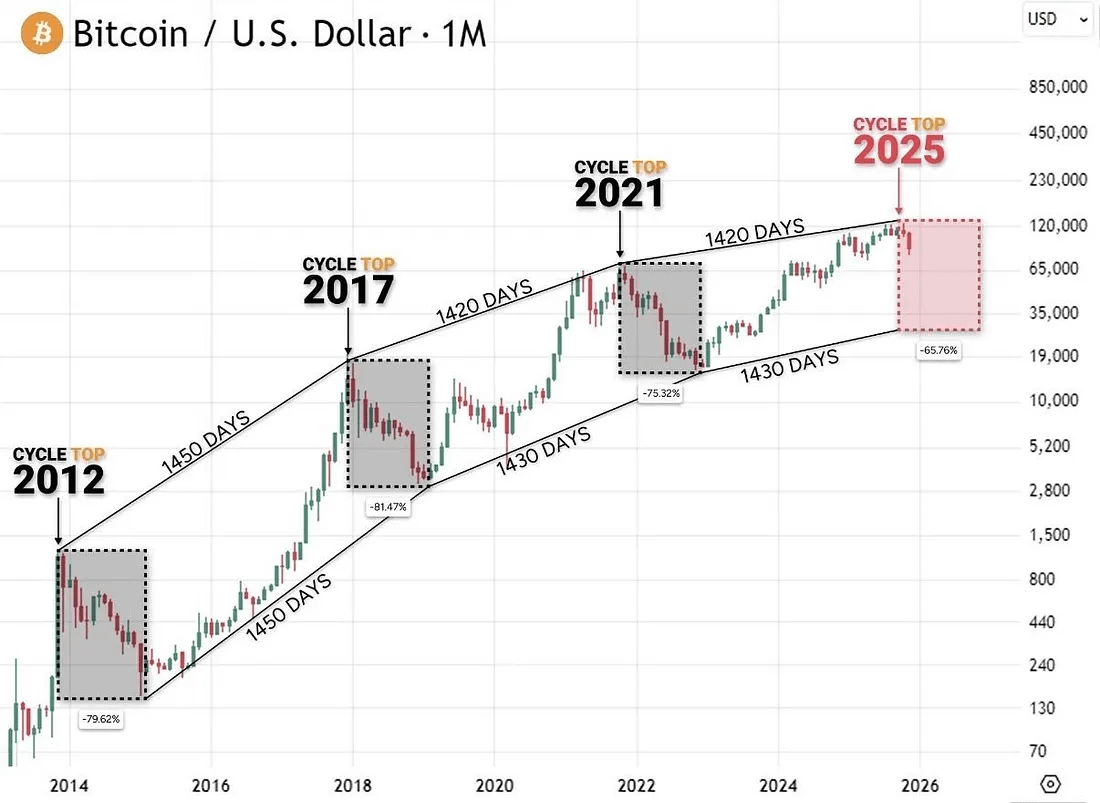
Yes.
The current drawdown is 46%. The 2018 bear was 84%. The 2022 bear was 77.5%. A drop to $35,000 would be a 72% decline. Painful, but within the range of every previous cycle.
The 200-week moving average sits at $58,000. This single line has marked the absolute bottom of every major Bitcoin cycle since 2015. It’s never been breached on a weekly close. If Bitcoin touches it and holds, that’s the most historically reliable buy signal the asset has ever produced.
Below that, the realized price (the average cost basis of all Bitcoin in circulation) sits at $55,000. When the market drops below this level, the aggregate holder is underwater. It’s happened before. It’s recoverable.
So yes. $35,000 is possible. It would be excruciating. And it wouldn’t mean Bitcoin is dying. It would mean Bitcoin is doing what it always does: punishing the impatient and rewarding the patient.
The thing retail doesn’t see
This is where the analysis gets cold.
On February 5, the single worst day of the crash, whale wallets absorbed 66,940 BTC into accumulation addresses. That’s $4.3 billion in one day. The largest single-day whale accumulation since 2022.
In the first two weeks of February, wallets holding 1,000 to 100,000 BTC added over 70,000 BTC. Whale holdings surged to 7.17 million BTC. A four-month high. At the exact moment that retail investors were selling everything.
Strategy (Michael Saylor’s company) holds 714,644 BTC at an average cost of $76,056. He’s underwater by $4.8 billion. He’s still buying. He added 1,142 BTC the week of February 9. The company has zero forced-selling risk. All Bitcoin is unencumbered. No collateral pledges. $2.25 billion in cash. The first convertible note put date isn’t until Q3 2027. Saylor says there’s no liquidation risk unless Bitcoin falls to $8,000 and stays there for years.
BlackRock’s IBIT was the only major ETF attracting inflows on the worst crash days. On February 5, it hit record trading volume of $10 billion. It pulled in $231.6 million in new money while every other fund bled. Larry Fink publicly stated that sovereign wealth funds bought Bitcoin at $120,000, $100,000, and through the $80s. His exact words: “This is not a trade. You own it for a purpose.”
Exchange reserves peaked on panic day and saw their largest single-day drop the next day. 16,889 BTC pulled off exchanges in 24 hours. That’s not selling behavior. That’s cold storage accumulation.
The pattern is unmistakable. Retail sells. Whales buy. Every cycle. Without exception.
The sovereign game
Twenty-seven countries now hold Bitcoin exposure. Sixteen nations have proposed or enacted legislation for strategic Bitcoin reserves.
The US holds an estimated 198,000 to 328,000 BTC from criminal seizures. Treasury Secretary Bessent confirmed it won’t be sold. Trump signaled on February 15 he’d “explore new ways to accumulate additional Bitcoin for the reserve.” No open-market purchases yet. But the BITCOIN Act proposing acquisition of 1 million BTC over five years is on the table.
El Salvador buys 1 BTC every single day. They haven’t stopped once. Not when Bitcoin was at $126,000. Not when it crashed to $60,000. They hold 7,550 BTC now.
Abu Dhabi’s Mubadala tripled its Bitcoin ETF stake. The Czech National Bank made an experimental purchase. Brazil is considering a reserve of 1 million BTC. Texas became the first US state to fund a crypto reserve. Switzerland has a national referendum campaign underway.
This is game theory in action. Once one nation accumulates, others can’t afford not to. The cost of being wrong about Bitcoin and holding some is moderate. The cost of being right about Bitcoin and holding none is catastrophic. Governments understand this math even when their economists don’t.
My read
Bitcoin isn’t going to zero. That thesis requires every holder on earth to sell simultaneously, something that hasn’t happened across five 70%+ drawdowns over 17 years. It requires you to ignore $97 billion in ETF assets, sovereign reserves in 27 countries, 714,644 BTC held by a single corporation with no forced-selling risk, and a self-correcting mining network that adjusts difficulty downward when miners exit.
Could it go lower from here? Absolutely. $58,000 is on the table. $45,000 is possible in an extreme scenario. If you can’t stomach that, you shouldn’t hold Bitcoin. Full stop.
But the signal that matters most isn’t the price. It’s the behavioral divergence. Retail investors are panic-selling at levels last seen during the FTX collapse. Whales are accumulating at the fastest pace since 2022. Sovereign wealth funds are buying through the dip. The world’s largest asset manager is publishing bullish research notes. Nation-states are building reserves.
The “pragmatic” people telling you Bitcoin is worthless because the world trades in fiat and gold are making a static argument about a dynamic system. Yes, the world trades in fiat. It also traded exclusively in gold coins once. And in cowrie shells before that. The medium of exchange evolves. It doesn’t ask permission first.
The real question isn’t whether Bitcoin goes to zero. The real question is whether you’re positioned alongside the whales and sovereign funds, or alongside the retail traders they’re buying from.
The data on that question is not ambiguous.