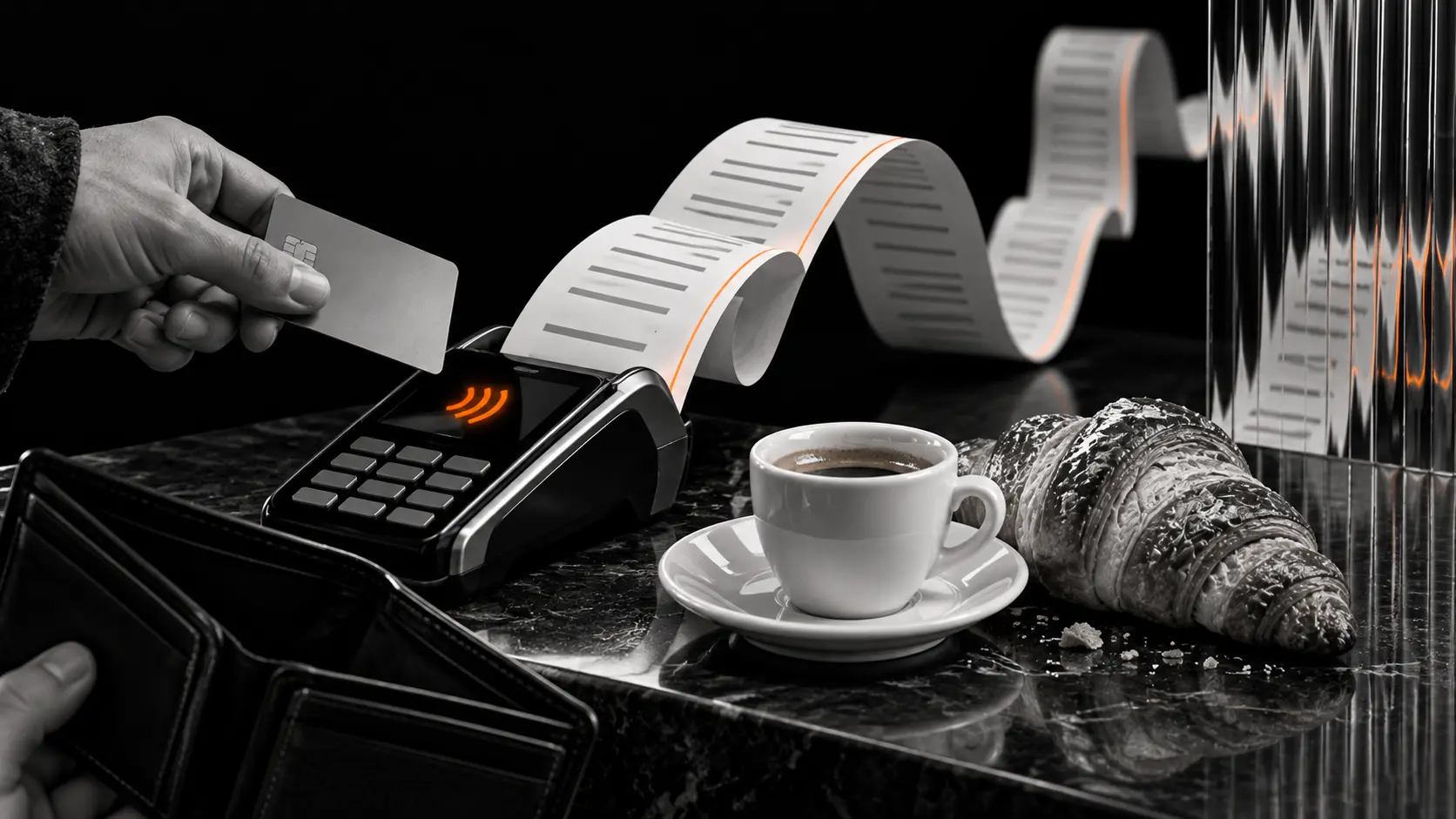
I’m in a café in Lausanne. I order an espresso. 4 francs. A croissant sits next to it on the counter. 1.70.
The croissant is butter, flour, eggs. Shaped, proofed, baked, packaged, transported. The coffee is hot water pushed through ground beans for 25 seconds. The croissant costs less than half the coffee. Think about that ratio for a second. The item requiring craft and perishable ingredients costs less than the item a machine produces in under a minute.
Down the street, Migros sells espresso from a self-service machine. One franc. Migros isn’t a charity. That one franc covers the beans, the machine amortization, the electricity, the cup, and still leaves a margin. So the actual cost of serving you a coffee in Switzerland is somewhere south of 1 CHF. When the café charges 4.50, that’s not “experience pricing.” That’s not “Swiss wages.” That’s a 350% markup over what a profitable Swiss retailer already makes money on.
Something is wrong. You feel it every time you pay. You push it down because everyone else is paying. You’re not crazy.
This detachment has a name. Price alienation.
It’s not everything. That’s what makes it work.
If every product got priced this way, people would revolt. The system is smarter than that. Rice is still cheap. Pasta at the supermarket is cheap. Generic clothes are cheap. The baseline of survival has stayed accessible enough that the pressure never breaks.
What’s been captured is lifestyle. The coffee with a friend. The lunch out on a Tuesday. The pastry on Saturday. The pizza with the family. The sandwich between meetings. The branded products that signal you’re doing fine. None of these are survival. They’re the small transactions that make modern urban life feel livable. And one by one, they’ve been priced into an extraction zone where you feel the sting every time you tap the card.
You can skip fake luxury. You can refuse an Apple product. You can’t refuse to eat lunch.
That’s the alienation. Not the baseline cost of living. The tax on your normal life.
The Migros paradox, or the price of a story
Walk into Migros in Lausanne. The chilled cabinet with prepared meals. One is labeled with a handwritten-style font, a little story about the chef, something about local sourcing. 17 francs. Right next to it, a mainstream prepared meal. Same kind of dish. 5 francs. Maybe slightly smaller portion. Maybe slightly simpler ingredients. Not three times worse. Not anywhere close to three times worse.
The story costs you 12 francs.
And people buy it. I’ve bought it. That’s the part you have to say honestly. We pay for the story, we pay for the packaging, we pay for the feeling of having chosen well. The extraction works on us because it’s designed around us.
What a sandwich actually costs in Switzerland right now
A sandwich in Lausanne or Geneva starts at 13 francs. Average sits between 16 and 20. A good one, with proper bread and decent ingredients, pushes past 20. The stuff inside it, bread, ham, butter, lettuce, costs the seller maybe 2 francs at wholesale.
A prepared pasta portion from a takeaway counter, barely any meat, industrial quality from a distributor, goes for 15 francs. A single cannelé is 3.50. A pizza runs 21 to 25 francs.
Here’s the comparison that kills the “cost structure” defense. You can walk into a proper restaurant, sit down, and get a three-course meal for 25 euros. Full kitchen brigade, waitstaff, three separate preparations, real technique. If that restaurant can serve you all of that at 25 euros and stay in business, then the pizzeria charging 25 francs for dough, sauce, and cheese has no excuse.
The shoe that crossed an ocean for less than your sandwich
A pair of Adidas Stan Smith costs 59 francs. Leather sourcing, factory labor in Southeast Asia, quality control, ocean freight, customs, continental distribution, retail margin, and a global marketing budget. The shoe crosses oceans.
The sandwich crosses a room.
They’re approaching the same price. Sit with that for a second.
This is not inflation
Inflation is when input costs rise and prices follow. What’s happened in the last five years is something else.
Economist Isabella Weber analyzed nearly 139,000 corporate earnings call transcripts. What she found: executives express positive sentiment about economy-wide cost shocks. They see them as opportunities, not problems. When everyone faces the same cost increase, every business can safely raise prices knowing competitors will do the same. No collusion needed. No phone calls between pizza shop owners. The shared cost shock becomes the coordination signal that replaces the conspiracy nobody had to organize.
She called it sellers’ inflation. The ECB confirmed the mechanism. Corporate profits drove roughly two-thirds of eurozone domestic price pressures in 2022. In the US, 54% of price growth since mid-2020 came from fatter profit margins, against a historical norm of 11%. These aren’t fringe claims. The central banks published them.
Your corner café isn’t Starbucks. It’s running the same playbook anyway.
The greedflation conversation always targets Nestlé, PepsiCo, Loblaw, Starbucks. Comfortable villains. Easy to hate.
Your local pizzeria isn’t Nestlé. Your corner café isn’t Starbucks. The sandwich shop isn’t a publicly traded company. These are small operators, sometimes family-run, and they’re doing the exact same thing. The mechanism isn’t corporate structure. It’s a cultural pricing consensus that works at every scale. The café owner looks at the café next door, sees 4.50, and prices at 4.20 thinking he’s being reasonable. Nobody does cost-plus pricing from ingredients up. Everyone does market-matching pricing from competitors sideways.
And when the whole market has drifted into extraction territory, “matching the market” means matching the extraction.
This is why the small-business version is harder to fight than the corporate one. You can boycott Loblaw. You can’t boycott every independent café in your city.
A tax on thirst, dressed up as hospitality
The extraction concentrates on liquids. Coffee, juice, wine by the glass, anything poured. Beverages carry gross margins of 70 to 90%. Food sits at 60 to 75%. A fountain soda costs 5 to 15 centimes to produce and sells for 2.50 to 3 francs. The paper cup is more expensive than the liquid inside it. Your glass of wine that costs 8 francs came from a bottle the restaurant paid 1.20 for.
Restaurants keep food margins competitive to get you through the door. Then they recover profitability through the drink program.
You walk in thinking you’re being hosted. You’re being harvested.
The three machines that made all of this possible
This street-level consensus doesn’t run on its own. It sits on top of three larger mechanisms that have been quietly running for fifteen years.
The first is monetary flood. Central banks created currency at rates without historical precedent since 2008. That money didn’t land in wages, which would have risen. It landed in assets. Everything investors touch went vertical. Everything workers earn stayed flat. The café owner raising his coffee from 3.50 to 4.50 is operating inside a monetary regime that has already pumped fake purchasing power into the system. He’s not the cause. He’s downstream.
The second is statistical fiction. Official inflation indices aren’t measurements. They’re constructions. Hedonic adjustment lets a TV that sells for 800 euros be recorded as costing 400, because it’s “twice as good” as last year’s model. Core inflation strips out food and energy so the headline can report calm while people burn through savings to eat. The index drifts at 2 percent while a real basket tracks at 15 to 20. The government has cover. The lived experience has nothing.
The third is platform normalization. Uber prices by demand. Amazon changes prices by the second, by user, by perceived willingness to pay. Airlines made dynamic pricing normal, and once a generation grew up inside that logic, the café charging 4.50 on Saturday and 3.80 on Tuesday feels like the natural order of things. Two humans buying the same thing at different prices used to be partially illegal. Software made it normal.
Monetary flood gives the café owner cover. Statistical fiction gives the government cover. Platform normalization gives you no reference point left to argue with.
Why you keep paying anyway
Here’s the part the macro analysis can’t explain. Why do you keep paying?
You’re not stupid. You know 4.50 is absurd for a coffee that costs the shop under one franc. You felt it the first time. Then you paid again.
Part of it is that everyone around you is paying. To refuse is to make a scene. To walk out is to be that person. Social shame is the cheapest enforcement mechanism the system has, and it uses it constantly.
Part of it is class signaling. The alternative feels humiliating. Bringing your own sandwich to the office. Drinking the office coffee instead of the good one downstairs. There’s a status signal embedded in every one of these transactions. Paying the tax is how you stay inside the class you think you belong to.
Part of it is decision fatigue. You can’t optimize every small purchase or you’d never do anything else. The coffee shop knows this. The pricing is calibrated to be expensive enough to matter in aggregate but not quite expensive enough to trigger a refusal in the moment. It’s a perfect design.
And part of it, the deepest part, is that we’ve forgotten what things should cost. Price memory is dying. The 4.50 coffee is just the current number. The 20 franc sandwich is just what sandwiches are. Without a baseline, there’s nothing to resist.
This is the alienation in full. Not just that prices detached from value. That we detached from our own judgment about what we’re paying.
France: where the denial is loudest
The French case is the cleanest because the gap between official story and lived story is the widest.
Median wage effectively stable since 2000. Around 35k a year. Property index went from 30 to 120 in the same window. Four times higher. Rent followed. Restaurants doubled. Electricity climbed 30 percent. Meanwhile INSEE announces 2 percent inflation year after year, and ministers cite the figure to prove nothing is wrong.
29% of French people now skip meals. Budget products, the ones poorest households buy, rose 30% since 2021. Economists say the population is irrational. The population says life has gotten harder every year. Both are technically right. They’re measuring different things.
The gap between them is where the alienation lives.
Switzerland: where the link still holds, for now
From the outside, Switzerland looks impossible. Eighteen francs for a burger. Four for a coffee. Two thousand for a modest monthly rent. Travelers come back with horror stories.
That’s not what’s happening inside. Swiss wages track Swiss prices. A plumber in Lausanne earns enough to live in Lausanne. A hotel porter at a five-star in the mountains, which I was for a while, makes enough to buy Swiss meat, Swiss rent, Swiss train tickets, Swiss health care. The absolute numbers are high because the whole system operates at a high nominal level. The ratio is defended.
This is what most European countries used to have. Most gave it up. Switzerland kept it through some combination of monetary sovereignty, collective bargaining, and plain stubbornness.
But the Swiss cushion is shrinking every year
Health insurance premiums climb 6 to 10 percent a year while wages creep at 1 to 2. Rents in the Lac Léman arc are starting to look Parisian. The luxury segment has completely decoupled from local reality. The palace hotels where I worked now charge prices that even wealthy Swiss locals won’t pay. It’s all Gulf money and American tech money. When a product category prices itself out of its own domestic market, the link between labor and price has broken at the top. And the break always migrates down.
The café charging 4.50 is the migration arriving in the neighborhood.
Run the math. Someone earning 4,500 CHF net. One coffee and one modest lunch out, five days a week. 400 to 500 CHF a month. Ten percent of take-home pay. For a sandwich and a coffee.
What breaks inside a person when prices stop meaning anything
Saving feels stupid. Your cash melts in the drawer. The rational move is to spend or speculate. Neither builds anything that lasts.
Work stops feeling fair. When forty years of labor can’t buy what twenty years used to, something snaps inside the contract between effort and outcome. That’s not a mood. That’s arithmetic.
Memory of value dies. You pay whatever appears on the screen because you have no reference point to argue with. The merchant doesn’t have one either. The price came from upstream, from algorithms, from pricing committees, from regulatory layers nobody fully understands.
And planning collapses. If you can’t project the cost of a kilo of rice in five years, you can’t plan a family budget over ten. You can’t decide what size pension you’ll need. You can’t choose between renting and buying with any confidence. So you stop deciding. You react, month to month, hoping the number doesn’t climb too fast this time.
This is the real damage. Not the euros out of your wallet. The slow erosion of your ability to plan a life.
Build your own index. Stop trusting theirs.
You can’t fix the system. You can refuse the fiction in your own life.
Track your own basket. Write down what a loaf of bread, a square meter of rent, a kilo of beef, a dentist visit cost you this year and last. That’s your index. It won’t match the official one. Use yours.
Identify your personal extraction zones. For most urban professionals, it’s the coffee and the sandwich. That’s where the densest daily bleed happens. The aggregate is 400 to 500 CHF a month in pure transfer to businesses copy-pricing each other into extraction territory. That money compounds if you redirect it. It doesn’t compound if you hand it to someone marking up boiled water two thousand percent.
Cut what you can cut without resenting yourself. Cook more. Buy the 5 franc prepared meal at Migros, not the 17 franc one with the story. Drink good coffee at home most days and enjoy the café one when it’s actually worth it. Take back the transactions, one at a time.
The arbitrage nobody’s running yet
When an entire market prices at 10 to 20 times production cost because everyone copies everyone, any operator who prices at 2 to 3 times cost captures the entire price-sensitive segment while still running healthy margins. You don’t need to be cheap. You just need to be honest. And the gap between honest and normal is so wide right now that honest looks revolutionary.
Self-service coffee machines have gotten genuinely good. The commercial-grade ones from Jura, WMF, or Franke pull better, more consistent shots than most baristas. Fresh beans, proper grind calibration, real milk frothing. Put 15 or 20 of them in a warm, well-designed space. Good chairs. Nice lighting. One employee to keep things running and human. Price at 1.50 CHF. You’re still 8 to 10 times above your ingredient cost. That’s a healthy margin. But you’re half what everyone else charges, and your coffee is better because the machine doesn’t have a bad day.
The volume math works. The standard objection is “I need 4 francs per coffee to cover my rent.” That math assumes 150 cups a day. If you’re the cheapest quality coffee in town by 50%, you’re serving 400 to 500. Rent is fixed. Labor is mostly fixed. Each incremental coffee costs you 0.20 francs. Unit economics get better as you go cheaper and higher volume.
Costco’s $1.50 hot dog hasn’t changed price since 1985. IKEA’s food courts sell meatball plates at near cost. Migros proved 1 CHF coffee works in Switzerland. These aren’t loss leaders. They’re profitable products that create fanatical loyalty because they respect the customer’s intelligence.
Why nobody’s done it yet (and who will)
The real barrier isn’t operational. It’s social. Pricing below your neighbors feels aggressive in Swiss and French food culture. There’s a guild mentality. The baker charging 1.20 when everyone charges 1.70 isn’t celebrated as efficient. He’s suspected of cutting corners. Which means the disruptor probably can’t come from inside the industry. It has to be someone who sees the unit economics cold and doesn’t care about the unwritten rules.
Make pricing transparency part of the brand. Show the cost breakdown. “This espresso costs us 0.18 CHF in beans. We charge 1.80. Here’s why.” Nobody in food service does this. The first brand to weaponize pricing transparency would own the conversation and turn every customer into an evangelist.
Someone is going to do this at scale in European food service. The entire market is begging for it. Every person who looks at their receipt and feels that quiet sting of being overcharged is a future customer for whoever builds it.
What your grandparents knew and your children won’t
Your grandparents could tell you what a coffee cost. What a loaf of bread cost. What an hour of their labor bought in meals, in clothes, in small moments out in town. That knowledge was real. It was useful. It let them push back when a merchant charged too much.
Your children won’t have the same certainty about anything.
That’s the measure of what’s been lost. Not the number. The memory of what numbers meant.
And the only question, for the people still paying attention, is who moves first.