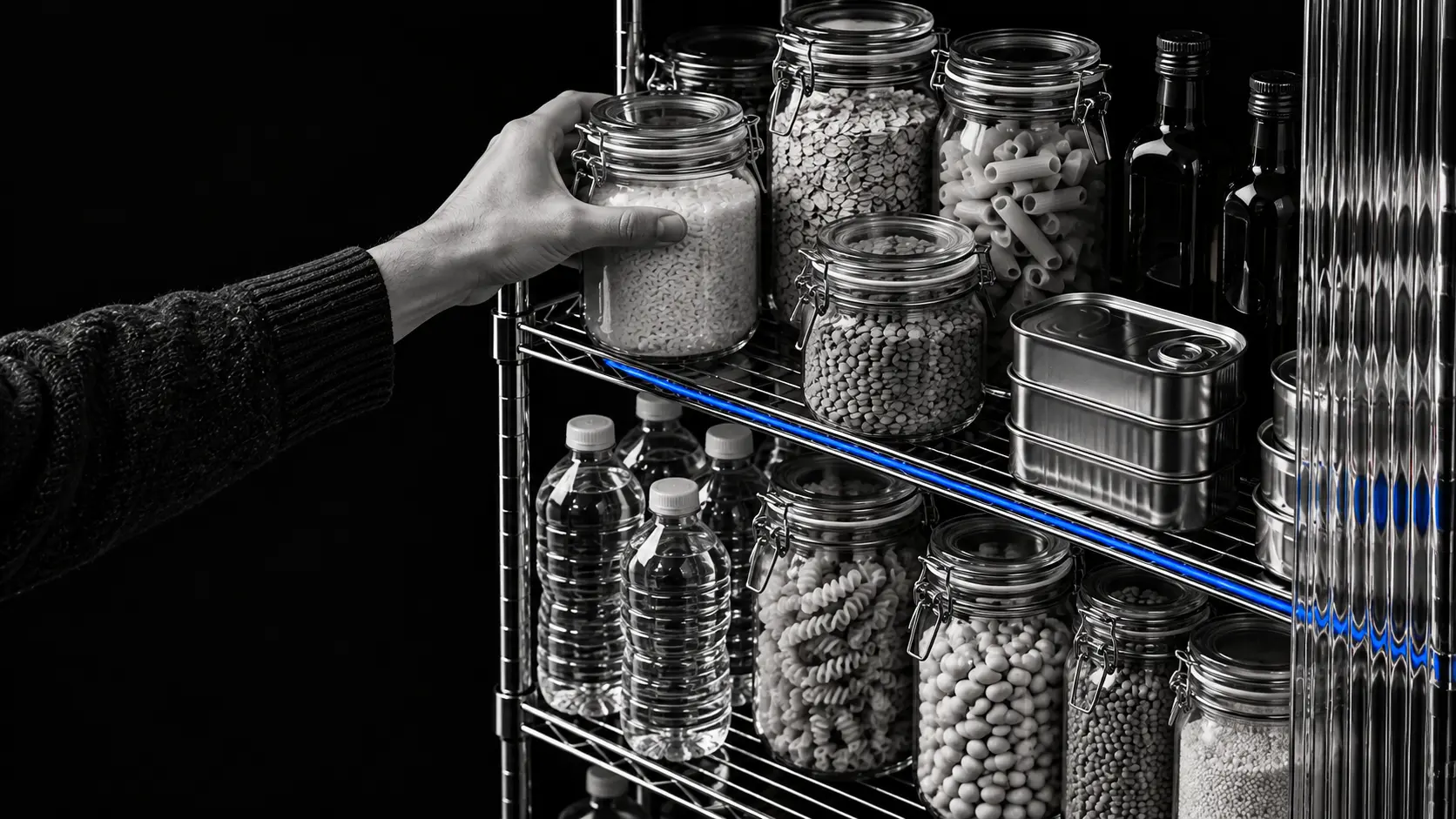
You own a seatbelt. You don’t plan on crashing. You don’t rehearse the impact, don’t picture your skull against the windshield every morning on the way to work. But the belt is there. And if the day comes, it’s the difference between bruised and broken.
A food reserve works the same way.
Not because you’re paranoid. Not because you think the world ends Tuesday. But because supply chains are fragile, prices are volatile, and the gap between “everything’s fine” and “shelves are empty” is shorter than most people are willing to admit.
Right now, the Strait of Hormuz is effectively shut down. Iran threatened to set fire to any ship crossing. Most major carriers suspended transit. This 39-kilometer chokepoint handles roughly a third of the world’s traded fertilizer, including 50% of global urea exports, 50% of sulfur exports, and 20% of global LNG. Qatar’s largest industrial complex already halted ammonia and urea production after drone strikes. Urea prices jumped 27% in days. Ammonia 16%. Phosphate 6%.
This isn’t about oil. It’s about what oil becomes. Fertilizer feeds the soil that feeds the crop that feeds you. Cut the fertilizer, and within months, you’re paying triple for the same bag of pasta. Not because there’s no pasta. Because there’s not enough wheat to make it cheaply.
That’s the thing people miss about food prices. They don’t rise because food disappears. They rise because one input in a chain of fifty gets disrupted, and the cost cascades forward into your grocery bill before you’ve even heard the news.
I lived a smaller version of this in Spain, 2023. The olive oil brand I always bought was 8 euros. Within six months, it was 16. Spain produces 45% of the world’s olive oil, and two consecutive years of drought crushed production by half. Prices didn’t just “go up.” They doubled overnight and never fully came back down. The brand eventually settled around 13 euros. Still 60% more than where it started.
But I didn’t pay any of that. I had a few bottles in advance. Olive oil stores well for two to three years depending on quality and storage conditions. My reserve absorbed the shock. Zero cost. Zero stress.
This is the principle: you don’t stockpile food to survive the apocalypse. You stockpile food to absorb price shocks, bridge gaps between jobs, or simply not panic when the news cycle goes sideways. It’s financial insulation as much as physical preparedness. It’s autonomy. It’s the quiet kind of independence that doesn’t need a manifesto, just a shelf.
Most people have outsourced their survival to a system that runs on just-in-time delivery. Three days of disruption and grocery stores are stripped bare. That’s not a conspiracy theory. It’s logistics math. And the fix is embarrassingly simple.
So here’s the framework. A 100-day food reserve for one adult, for under 100 euros. This was calculated at 2022 French supermarket prices, so adjust for inflation in your area. The concept holds regardless of where you live.
Thanks for reading! Subscribe for free to receive new posts and support my work.
The caloric foundation: cereals
Spaghetti, 5kg. Rice, 5kg. Semolina, 4kg. Oats, 3kg.
That’s your energy floor. 150 grams of dry cereal per day. Oats and semolina have the added advantage of working with cold water if cooking fuel is scarce. Rice and pasta need heat, but they’re cheap and store practically forever.
The protein engine: legumes
Blonde lentils, 2kg. Red beans, 2kg. Chickpeas, 2kg. Split peas, 2kg.
75 grams of dry legumes per day. Here’s the part most people don’t know: when you combine cereals and legumes in a two-thirds to one-third ratio, the amino acid profiles complement each other. You get a complete protein source. No meat required. This isn’t a vegan argument. It’s biochemistry. Military survival training uses this exact principle for austere environments.
Legumes demand long cooking times, which eats fuel. Soak them 12 to 24 hours beforehand and you cut cooking time by half or more. A small thing that matters a lot when your only heat source is a gas canister.
One more trick: you can sprout legumes and some cereals for a few days before eating them. It boosts protein content by roughly 20% and adds micronutrients you won’t get from the dry version. Costs nothing. Takes nothing but time and water.
The fats
Olive oil, 2 liters. Rapeseed oil, 2 liters. Three to four tablespoons per day.
Fat isn’t optional. It’s how your body absorbs vitamins A, D, E, and K. Skip it and the rest of your reserve becomes nutritionally crippled. Both oils have solid nutritional profiles. After two or three years of proper storage they may taste slightly off, but that’s a quality issue, not a safety one. Important distinction most people get wrong: the label on most oils shows a DDM (best-before date), not a DLC (use-by date). Past the DDM, the taste degrades. It doesn’t become dangerous. Don’t throw away oil that smells fine just because a date passed.
The cans
Sardines in olive oil, 22 cans. Mackerel, 10 cans. Tuna, 5 cans.
Canned fish gives you omega-3s, calcium, vitamin D, B12, phosphorus, and dense protein that keeps for years. Realistically, decades. The use-by dates on cans are regulatory minimums, not expiration cliffs. As long as the can isn’t damaged, swollen, or foul-smelling at opening, you’re fine. Spread them across the 100 days. They’re your nutritional anchor.
This is the animal protein in the stock. On a budget build like this, canned fish gives you the best density-to-cost-to-shelf-life ratio available. If you want to go further, beef jerky and dried meats are excellent but expensive, and this stock is designed so anyone can build it in a single grocery run without thinking twice about price. Get the first reserve done. Optimize later.
The essentials
Coarse salt, 500g. Pepper (whole grains), 90g. Powdered sugar, 1kg. Powdered skim milk, 600g. Wine vinegar, 75cl.
Salt is essential to life. In a disruption scenario, it’s historically one of the first things people scramble for. Whole peppercorns keep far longer than ground. The sugar isn’t there for pleasure. It’s a rapid energy source when tonus drops, and it makes oats and semolina bearable day after day. Powdered milk adds variety and nutrients, especially for breakfasts, but it’s chemically unstable. After two to three years it can change color and degrade. It’s the most sensitive item in the stock. Vinegar does double duty: seasoning and cleaning. At 6% acidity it already handles some bacteria and salmonella.
Total in 2022: 98.79 euros.
That’s 100 days of survival-grade nutrition for less than what most people spend on a single restaurant dinner for two. An adult can stay healthy on this for three months in full autonomy. Mix the semolina or oats with powdered milk and sugar for occasional sweet meals. It sounds austere. It is. But “austere and fed” beats “comfortable and hungry.”
A 13kg gas bottle and a basic burner lets you cook the entire stock with no electricity. For those without even that, a small supply of solid fuel tablets or tea light candles with a simple stand can handle basic heating.
Water:
Water deserves its own deep treatment, but the baseline is simpler than people think. I always keep a minimum of two weeks in advance. That’s surprisingly compact: two packs of six bottles (1.5 to 2 liters each). One pack per person per week covers drinking and basic cooking needs. Ideally, aim for four weeks or more if you have the space. And you probably do. Even under a single bed you can slide eight packs flat. That’s two months of water for one person, invisible, taking zero usable floor space. The storage constraint people imagine is almost always worse than the reality.
Storage rules:
Before long-term storage, put rice, pasta, cereals, and legumes in the freezer for 48 hours. This kills any larvae or insects hiding in the packaging. After that, store everything cool, dry, dark. A cellar is ideal. A closet works. Drop a few fresh bay leaves into your containers to repel food moths. Costs nothing.
Cereals and legumes stored properly last decades. You won’t need them that long. But knowing they won’t go bad takes the pressure off.
The rotation principle:
A stockpile you forget about is a stockpile that rots. Eat from the reserve. Replace what you consume. First in, first out. The stock isn’t a museum exhibit. It’s a living buffer that absorbs shocks while staying fresh.
Upgrades worth considering:
Clarified butter (ghee). Takes time to make, stores for months without refrigeration, and improves nutrient absorption from everything you eat with it. If you’re going to have one luxury fat in a crisis stockpile, this is it.
Baking soda. Shortens cooking time for legumes (saves fuel), works as a cleaning agent, a basic antacid, and a dozen other uses. Costs almost nothing.
Spices. Turmeric, cloves, cardamom, cinnamon. They’re not decoration. Turmeric is anti-inflammatory. Cloves are antiseptic. Cardamom aids digestion. Your food reserve doubles as a basic pharmacy when you stock the right seasonings.
On grains: if budget allows, go semi-complete or brown rice rather than white. More fiber, more micronutrients, better sustained energy. Same logic for pasta. And quinoa, if you can find it cheap, contains all nine essential amino acids on its own.
What this is, and what it isn’t:
This is a budget framework. It takes about one square meter of shelf space. It works in a studio apartment. You can build it in a single grocery run. It’s designed for people who’ve never thought about food reserves and need a first step that isn’t overwhelming, expensive, or paranoid.
It won’t cover every scenario. It’s intentionally food only. Candles, lighters, a first aid kit, a water filter, extra batteries, a hand-crank radio. All worth adding. But they’re extensions of the same logic. Start with food because food is the one thing you can’t improvise when you suddenly need it.
And that’s the real point. This isn’t about bunkers or doomsday. It’s about taking back a basic piece of responsibility that modern life has quietly removed from your hands. You’ve been trained to trust that the store will always be stocked, that the trucks will always run, that the price you paid last month is the price you’ll pay next month. Sometimes it is. Sometimes a 39-kilometer strait closes and the math changes overnight.
The Hormuz crisis will resolve or it won’t. The next disruption will be something nobody’s talking about today. Olive oil, fertilizer, a drought in the wrong province, a port strike, a currency shock. The trigger doesn’t matter. What matters is whether you’ve already absorbed the first three months of impact or whether you’re standing in line paying three times the price for half the stock.
A hundred euros. One afternoon. One shelf.
That’s the seatbelt.